You Jabronies Don't Even Know What Tactical Combat Means
Table of Contents
Game mechanics struggle to create tactical and strategic depth—they can't really, except incidently. Tactical depth arises from the conventions of a table and the mindset of the participants. If the actual text of the rules engender tactics, it's purely because the players caught a vibe off the book, it's about as effective as doing positive affirmations of one's own greatness while staring at a portrait of Napoleon Bonaparte.
This is hardly news. It was realized by Prussian officers of yore and been muchly talked about quite well. What I'd like to yap about are some terms and general military-mindedness that I think will relate quite well to tactical combat in elfgames. None of this has to be adopted to achieve tactical depth (and honestly I sometimes enjoy less tactical games), but I hope to engender a mindset conducive to tactical combat in those who desire it. This actually began as a reply to “Boring” Combat is Fine Actually by Mr. Jenx with whom I mostly agree, but this is addressed to the community of wrongthinkers at large—the aforementioned jabronis.
My final disclaimer is that I don’t have real combat experience. I did one enlistment in the infantry, graduated my advanced school, and managed to pick up a few things along the way. In small unit tactics and the practical application of violence I confess to having only that counterfeit and secondhand (and quickly fading) knowledge of a peacetime Marine. However, the state of the discourse in the ttrpg sphere is one of such staggering confusion and incoherence that I feel moved to speak.
Observations
In the great wastelands, beneath the sheer cliffs of SEO optimized crap, when talk turns to “Tactical Combat” on the individual / small unit scale, the discussion revolves around two things:
- where to move
- who to hit—and with what weapon or special ability
This leads people to play combat as some sort of gussied up rock-paper-scissors, and is frequently lamented and bitched-about as:
- simplistic, boring, and unfun
- the be-all and end-all of tactics on this scale
The foolishness of the above beliefs, and their supposed remedy of Just More Shit To Do, is effectively covered by Misters Jenx and Rolltop Indigo, as well as others. What I will elaborate on is:
- The source of boredom,
- a definition of tactics,
- and how we can use meaningful tactics to not be bored.
The Source of Boredom
Here’s the the skinny: The source of our boredom is our own failures. These failures are:
- A failure of imagination; to play the only game worth playing, to embrace child-like wonder, to be creative.
- A failure of logic; to draw conclusions, to have quality self-guided thoughts, to analyze what has happened and coherently and consistently predict the consequential, to solve problems.
Notably absent are: playing the wrong RPG ruleset, inexperience with the ruleset, realism, not buying the right module, not watching enough tutorials, and not grasping the correct RPG theory.
“But how”, asks Strauh T. Mann, “–how can imagination and logic be enough to defeat boredom and do Tactical Combat™?”
Because creative problem-solving is tactics, and it is fun. Procedures, statistics, and methodologies can build upon your creative problem-solving skills—but if you cannot think creatively on your feet you are incapable of making tactical decisions. If you are using a ruleset or “ability set” to dictate your decision-making, you are not thinking tactically, you are merely pulling levers and pushing buttons provided to you like a rat in a Skinner box.
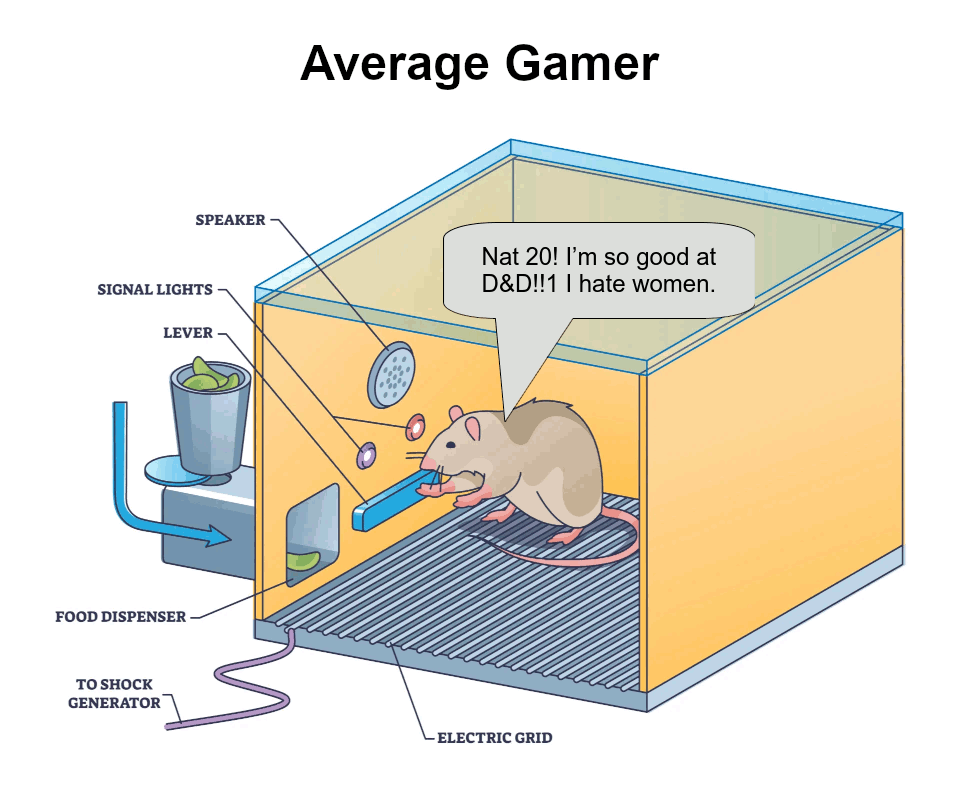
Luckily, unless you’re a web-scraping bot being trained to ruin our lives, you are capable of creative decision making—yay! You are a person totally capable of busting it down Tactical Style. You’ve maybe just picked up some brainworms from buying too many rulesets or engaging in unrefrigerated conversations. Fortunately, the psychic dewormer is on the house today, and it consists entirely of telling you things you already know.
Some Definitions & Their Importance
If’n we really desire to do Combat as War™(and this is kinda the zeitgeist in our wargaming-decended hobby) some working definitions are needed.
WAR.
The essence of war is a violent struggle between two hostile, independent, and irreconcilable wills, each trying to impose itself on the other. […] Clausewitz called it a Zweikampf (literally a “two-struggle”) and suggested the image of a pair of wrestlers locked in a hold, each exerting force and counterforce to try to throw the other. War is thus a process of continuous mutual adaptation, of give and take, move and counter move. It is critical to keep in mind that the enemy is not an inanimate object to be acted upon but an independent and animate force with its own objectives and plans. While we try to impose our will on the enemy, they resist us and seek to impose their own will on us. MCDP 1 (1-3)
…
An even greater part of the conduct of war falls under the realm of art, which is the employment of creative or intuitive skills. Art includes the creative, situational application of scientific knowledge through judgment and experience, and so the art of war subsumes the science of war. The art of war requires the intuitive ability to grasp the essence of a unique military situation and the creative ability to devise a practical solution. It involves conceiving strategies and tactics and developing plans of action to suit a given situation. This still does not describe the whole phenomenon. Owing to the vagaries of human behavior and the countless other intangible factors […] MCDP 1 (1-17)
TLDR: War is a struggle between two irreconcilable wills, acting and counteracting against each other. The greater part of its conduct is the employment of creative or intuitive skills to devise practical solutions.
This is a vital corroboration for the necessity of Morale Rolls/Adjudications; without which we are not modeling the struggles between forces of will, but instead lurching toward some kind of spacial math game, like chess but worse. It is also now clear that the objective in war and combat is not killing the enemy, it is eroding their will and ability to fight. Killing is merely an accidental consequence of physical violence, which just happens to be one way of imposing your will on your social environment. Methods such as subterfuge, theft, politics, trade, rhetoric, parlaying, construction, destruction, dissemination, boasting, and innumerable others are also means of warfare.
VIOLENCE.
When you force your will upon your environment, you are doing violence. Every action taken to carry out your will is also violence. Movement is violence. You should move violently.
MOVEMENT.
When you take up a position and control the area, the shape of your unit changes, the field is altered, and the decisions available to the opposing force are constrained by your action. Movement is the most important tactical decision: “here I am, and here you cannot be.” As a combatant, you must own your space and not immediately give it up. If you fall back or break away from your unit, you are not a part of the unit’s surface but a gap in it.
Movement against advesaries or in an advesarial environment, can be called maneuver.
TACTICS.
Yeah, I’ve kinda already defined tactics as creative problem-solving. There’s some other tidbits in MCDPs that are relevant to ttrpgs.
“[…] the immediate exploitation of success to defeat the enemy.” —yes
“[…] includes the technical application of combat power, which consists of those techniques and procedures for accomplishing specific tasks within a tactical action.” —I initially avoided the ‘selecting from techniques’ type definition out of fear I’d reinforce the Sweet New Unlocks concept. While knowing when to Turn Undead or Brace a Pike is part of tactics; these abilities as they exist on your character sheet are merely symbolic of the skillful technique in the ✨Imagined World✨. In-world thinking is part of the mindset I'm trying to express, but what I really mean is: stop being an idiot and just play pretend. Tactics is doing what works. This isn't the realm of theory—it's a craft. Warcraft, a world of it (I'm really sorry). You could read the entirety of MCDP 1-3 Tactics but I entreat you to instead consider tactics:
The art & science of analyzing the situation, envisioning your desired endstate, and bridging that gap with both honed techniques and the unbounded potential interplay you have with your environment.
How You Can Use Tactics
This is the part that’s actually useful. I know, you thought it would never come.
The Process: Or How I Learned To Stop Worrying and Love Failure
The OODA loop. Observe >> Orient >> Decide >> Act—pretty much what it says on the can. Look this freaking image from wikipedia. Doesn't it look like a thought process that would summon demons or something? It won't, I promise.
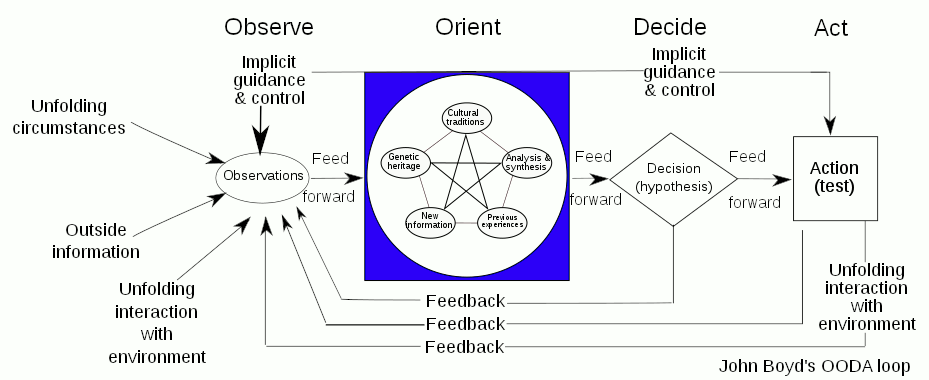
I'll get into how I'd implement this cycle later, but I want to hoist the idea of one up here in the post. You can use some other decision making framework (maybe the FRUIT loop) but you need something to order your thoughts.
Standard Operating Procedures, SOPs
There are some quite intuitive tactics, liking using a 10’ Pole, which are quickly added to one’s repertoire and can become standard procedures. While the simple heuristic skill of “learning what works” doesn’t require conscious practice, taking things further does. Here are some situations where a methodical approach should be attempted, an SOP formed, and communicated with the team.
- Bedding down for the night. What are our sleeping arrangements? Are we keeping watch, lighting a fire? When and how should the watch sound the alarm?
- Moving in a Line. aka marching order. Sketch a 1 wide and 2 wide formation to save time—you now only tell the DM when you deviate from this.
- Crossing a deep river in armor. Of course, someone can doff pack and plate to swim across with a rope; but with enough rope and some convenient trees you can suspend two lines above the water: one to walk across and one to hold onto. More people remain ready to fight and there's less chance of tragedy.
- Cresting a hill. No seriously, your body creates a very noticeable person-shaped silhouette against the sky. You can also see further from atop a hill.
- Fighting Monsters with Impregnable Hides or Elsewise Immune to Damage. You gotta do something man.
- Similarly, when the DM thinks up new and terrible foes the players must devise and remember ways to defeat them. Everyone knows to burn by-the-book Trolls and show the Medusa a mirror—but what about Scorpjackalopes and Xiblers?
- Encountering Fellow Travelers on the Road or Elsewhere. Any cultural considerations? Do we change formation—is that too aggressive? If they’re armed and stop at sighting you, do you send forth a person to parlay—will this be respected?
This might seem excessive but remember, you only have to decide an SOP once and can then refine or tweak the standard as the situation changes. Really, not doing this is excessive. Why not build and refine your tactics / strategies as a group? Why not write them down—it saves effort later.
You might have noticed that most of the above situations aren’t really Combat, well that’s because we’re talking about…
LEFT OF BANG
We’re talking about a timeline here, and the “bang” is the incident: the wandering monster, encounter, trap, enemy charge, or w/e. It’s the point at which you dispense with careful planning—and if you have laid plans, they're up for evaluation. During a battle, or what have you, players will face some stressors and complications, they will feel nervous and perhaps even paralyzed by so many decisions.
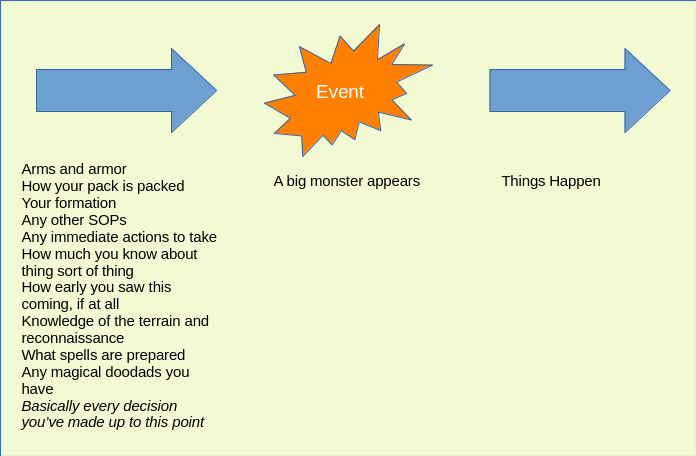
The bullet points got obliterated by LibreOffice, soz
You're trying to be proactive, but you are not trying to prepare for every eventuality. That would be a trap, as you cannot win hypothetical battles, only the one you're fighting. As with later stages, your ability to make accurate observations and glean quality information is vital.
An Example or Something
Let's say (and I'm going to keep using this example because it's the only one I can think of) you and your party need to travel the dangerous easterly road to the Baron's castle. You know the way is fraught because folks often dissappear, but you don't know why. As soon as you decide on a task, it is already underway and you are in the Planning Stage. I'm going to copy some acronyms from this handout for Marine Officers. I don't want to bore or veer too far away from RPGs (and 5 paragraph orders are officer shit, I only did it at school). So here's a modified Tactical Adventuring Steps: Plan, Implement, Supervise, Study.
Plan
In our quest to reach the Baron's castle we start by trying to figure out why the road is so dangerous, and we decide to ask around town. The townsfolk tell us the area is infested with brigands who are likely from a mercenary company the Baron dismissed last year. We decide to not question why the people are disappearing outright and not being robbed or ransomed.
We'll start by making an estimate of the situation in the form of a Mission, Enemy, Terrain, Troops, Time, and Civil Consideration (METT-TC). We assume that our brief survey and nonexistent reconnaissance will suffice.
Mission
Our mission is to get to the castle, alive. The "why" is to convince the Baron to hold a small tourney complete with jousting. Notably, we need to not only arrive at the castle but to not embarrass ourselves in the process by getting clowned on by bandits.
Enemy
We think the enemy are brigands (and we're wrong), and we make the following informed estimations:
- Size: Less than a company of men. We know that some were seen in town after being dismissed, on their way home or seeking other work instead of turning to banditry. We decide on 20 - 50 men.
- Activity: Ambushing travelers on the road, eating, drinking, and having a merry time.
- Location: They must be hiding the forest somewhere. There is a ruined old tower in there which they may have occupied. Other than that, the road. From our estimates of their numbers, and that fact that soldiers patrol the lands close to the castle, we think they only have 1 or 2 ambush positions.
- Unit: Not always relevant. We think these former mercs are northerners, we don't know what their company was called but we do know they fought on foot and cared little for foreigners (us).
- Time: If this was a formal report you could note the time it was delivered, to help inform of its accuracy, and we also note the freshness of our intel from the villagers (very fresh speculation). We don't know what time of day the bandits make their attacks, but that would be a key consideration here.
- Equipment: These were foot infantry, armed with pikes, axes, and sword. About a quarter carried shields and half wore maille armor—the rest gambeson. They may have stopped wearing armor around-the-clock when their discipline became lax.
Now we can derive a very important bit, the DRAW-D. Under what circumstances are our brigands able (or unable) to Defend, Reinforce, Attack, Withdraw, or Delay—and what are the likely triggers for each. The party considers this over beers at the local watering hole and concludes that the enemy will:
- Defend their hideout mightily but any ambush positions less so. We don't think they have any defenses against magic.
- Reinforce any ambush positions from camp(s) further hidden in the woods. They must have signaling horns from their time as legitimate mercs.
- Attack only after demanding money or ransom, this is of course what bandits do.
- Withdraw when they take more than a couple casualties. They can easily retreat into the woods and must be well established there by now.
- Delay us immediately, that's there whole thing.
Terrain, Troops, Time, & Civil Consideration
Yeah just gonna breeze through these, read the handout if you want. The terrain is heavily forested, offering cover and concealment to both friend and foe—they are surely taking advantage of this. The time it will take to reach the castle is about 7 hours if we travel on foot. Perhaps a day or two if we try to go through the woods. We do have a time constraint in that we need to reach the Baron as soon as possible before he makes other plans. Civil considerations include the old ruins in the woods and would also include all those kidnaped travelers (but our party forgets about that here too!).
Enemy's Most Likely Course of Actions
We decide, now quite deep in our cups, that the EMLCOA is too jump out of the bushes, demand money, and to take hostages if we fight or don't have enough money. If we try to fight they will likely sound horns and draw reinforcements from the forest.
This may also be the enemy's most dangerous course of action (EMDCOA), according to our estimation of their capabilities and limitations, other than slaughtering us in our sleep, but we don't plan to stop. We need to not get ambushed, and we could sneak around off the path, but the woods are fickle and we don't think we can afford the delay as that'd push us into our EMDCOA.
How can we exploit this situation?
The Plan
We're going to travel on the road and in the forest to either side In a big V formation, with the mouth of the V facing our direction of movement. Our hope is that this formation will force us to encounter any ambushers hiding in the treeline, and once encountered they will be inside our 'V' and we can quickly envelope them. If possible, we'll kill all, to a man, so they can't reinforce. If some brigands flee into the forest, we will take to the road and try to beat feet toward the patrolled lands around the castle.
If we make contact on the outside or rear of our formation, we'll call it out and try to pivot on the enemy. If we take more than 3 casualties we'll surrender or retreat, but we're going to leave that decision to Bill, the burly fighter leading the movement from the center of the group. Our newest member, a magic-user who refused to give his name, has promised us quite the show if we can get all the brigands in close proximity.
I'm Tired
Part 2 of this post, if it is gotten around to, will cover the rest of our beloved PISS as well as Immediate & Follow-on Actions. For now, I'm calling it early as I've sat on this thing far too long.
BONUS YAP: What The Ref Doin?
Tactical depth must be realized by the referee, but the players' tactics don't originate from the ref, nor the rules. I'd advise referees to put forth challenges without having a solution in mind. It makes it easier to throw things at your players and forces them to think (I think I came across this somewhere and will credit if I find it). Arbitrating things isn’t easy, and I’m by no means the best at it. We can lean on mechanics to give probabilistic outcomes and coherence, but some refs run their games well with just a 2d6 and ponder method. Ultimately, just one thing must be true:
Players’ decisions must be consequential and persistent.
How you figure it all out is a stylistic choice, there’s probably good ways to do it and bad ways—I have my opinions. But if a player has needle-bodkin arrowheads made because he knows his foes are wearing maille armor, that should matter. If a player is being attacked on 3 sides, that should carry some effect; even if it's just a -1 or an inability to retreat, it's your willingness to engage with your player's ideas that is important. From BX to GURPS to a black box in the DM's mind palace, there's a way to give depth to the situations in any game. The more abstract the rules, the more the game relies on the ref being well read and quick thinking.
SUB-BONUS YAP: Initiative
I've got a bone to pick about initiative. Having the initiative in a fight really means having the upper hand and having more control over the situation. This means that the side "with the initiative" is just the side who is already winning—until they aren't of course. Rewarding your players performance by letting them go first, and maybe making clearer the enemies intentions, or penalizing them by allowing the enemy to go first, can have a big impact. Losing the initiative is like taking a stumble in the zweikampf and should represent and model that happening.
This is easy in a system like Tunnels and Trolls where you can merely give the initiative to the side that last won the roll-off, but seems harder to me in other systems or to require GM fiat. T&T is, incidentally, a very tactical system (quick reminder that if you disagree with me you're wrong).
References & Links
- “Boring” Combat is Fine Actually by Jenx of Gorgon Bones. Time flies when you're lazy like me.
- METT-TC for Faction Play by MTB of Says Who. He totally ate my lunch. Actually tho, he approaches the METT-TC from the angle of strategic actions of GM-controled factions.
- SMEAC Briefings for TTRPGs by oldhawkeyes of Unturned Hovel. A powerful motivating force.
- YE COMPLEAT MANUAL OF UNMANNERLY FIGHTING by NBateman of Press The Beast. A jolly good read.
- Porn Logic by Rolltop Indigo. Follow the links, good stuff.
- MCDP 1 Warfighting
- MCDP 1-3 Tactics
- Tactical Planning Student Handout